Automatic Sanitary Stainless steel Grain Silo
An automatic sanitary stainless steel Grain Silo is an advanced, food-grade storage container that uses automated controls and smooth metal surfaces to keep grains clean, dry, and free from pests.
PRODUCT DESCRIPTION
Description
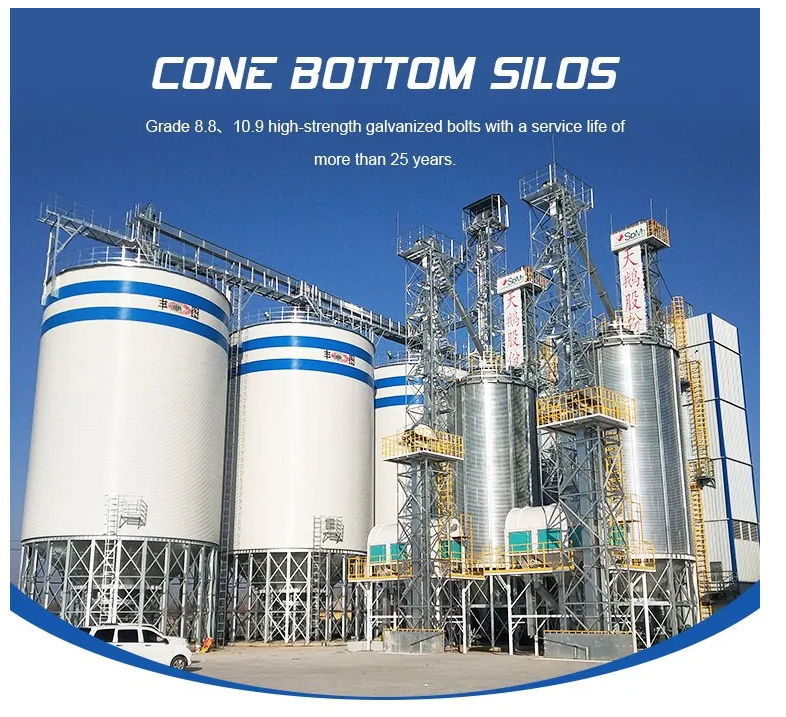
Grain Galvanized steel silos are manufactured using specialized technology and assembly lines, assembled with high-strength galvanized bolts.
A rigid frame, composed of multiple C-shaped or Z-shaped steel bars connected to a roof-type steel structure beam by high-strength bolts, enhances the overall seismic resistance, wind resistance, and stability of the prefabricated steel silo.
The silo walls are reinforced and can be machined with various process holes.
Steel silos are widely used in grain processing and transshipment due to their high land utilization rate, high degree of automation, short construction period, and low investment cost.
With the needs of economic development, a clear trend in the use of steel silos is the increasing capacity of individual silos.
Advantage & Feature
As a leading silo manufacturer, our silos are well-sealed to prevent leakage and moisture ingress.The wall panels and folded edges are joined using high-strength galvanized bolts, with embedded sealing strips or sealing strips, ensuring a tight seal and guaranteeing airtightness within the silo.
Especially after internal insulation and heat treatment, this ensures ventilation and disinfection of the grain, facilitating storage.
Production practice has proven that through reasonable process design, a sound auxiliary system, and safe and efficient grain reserve management, the quality of grain stored in steel silos can be ensured.
Prefabricated steel silos are easier to construct and have lower construction costs.
They are also simpler to manufacture, thus their use in modern construction is gradually increasing.
Key Features
● Food-Grade Material: Built from high-quality stainless steel (such as 304 or 316L) to prevent rust and chemical reactions with the grain.
● Sanitary Design: Features a non-porous, highly polished surface with rounded internal corners that stop dirt buildup and make cleaning easy.
● Automation: Connects to digital control panels and automated dosing systems to measure, load, and discharge grain precisely
● Sealed Environment: Uses airtight seals and pneumatic (air-powered) pipes to load and unload grain without letting in dust or bugs.
Main Benefits
● Pest and Mold Defense: Keeps out moisture, humidity, and insects that spoil stored crops.
● Better Hygiene: Smooth walls leave no leftover residue during emptying, which stops bacteria growth.
● Less Labor: Automated valves and sensors let operators manage inventory from a central screen without manual checks.
High-quality silos, Better service
Silo material: galvanized steel sheet. National standard 275g/m2, silo design life: at least 25 years of service life
Applicable Materials
Storage of grain and agricultural products
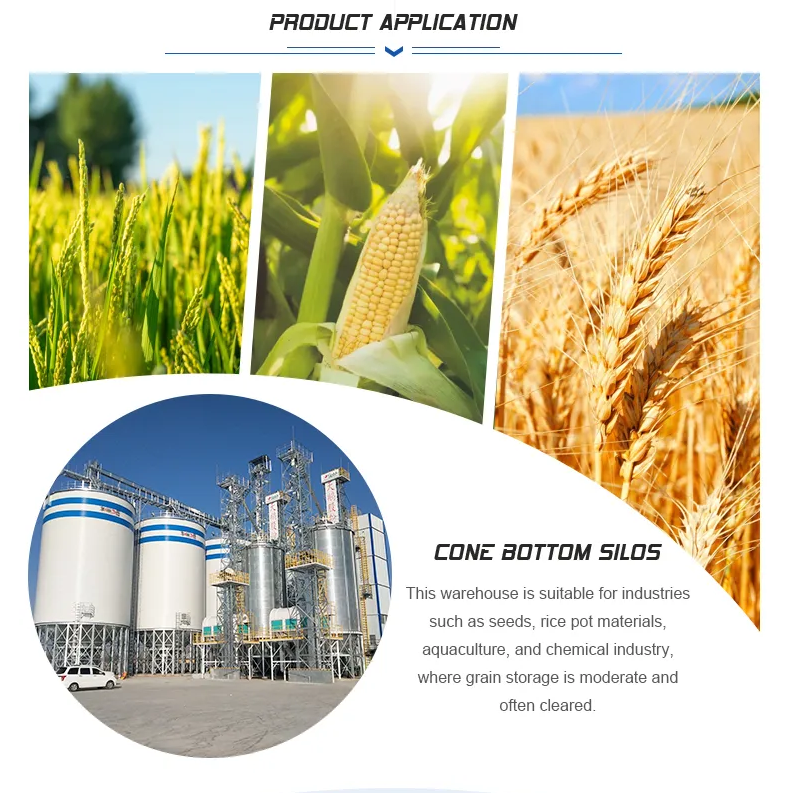
The most common application of silos is storing bulk agricultural products, including:
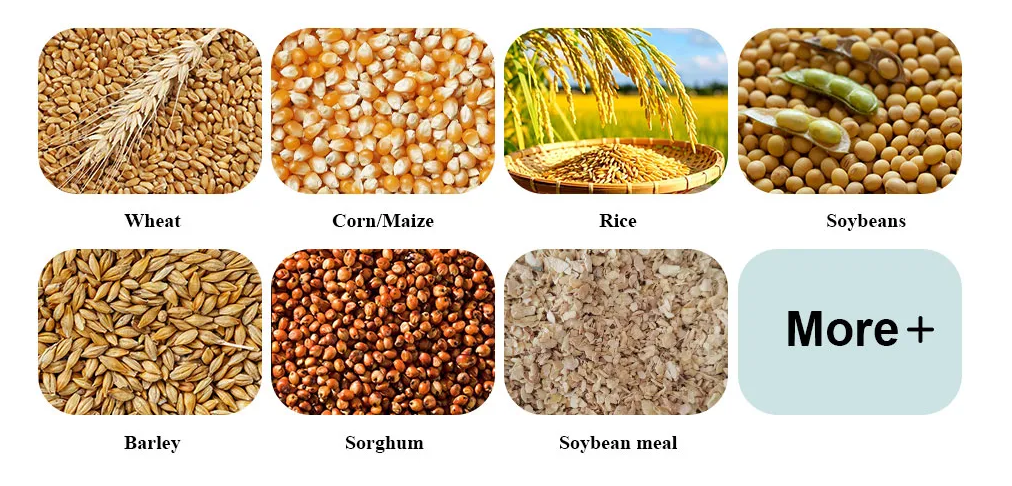
- Grain crops such as wheat, corn and rice
- Oil-bearing crops like soybeans, rapeseeds and sunflower seeds
- Feed raw materials and granular agricultural goods
Thanks to favorable sealing performance, silos can effectively block external moisture and pests, preserve grain quality, minimize losses, and improve storage & transportation efficiency.
Storage of Industrial Bulk Materials
In various industrial scenarios, enterprises also rely on silos to store a wide range of granular or powdery materials, such as:
- Coal and ores
- Sand, gravel and cement
- Chemical granules and resin raw materials
- By-products and recyclable materials from processing plants
Materials of this kind generally require large-volume storage as well as stable automatic discharging. The silo structure perfectly meets these requirements.
Customer Groups
The main customer groups for grain silos include flour mills, corn processing plants, rice mills, feed mills, wineries, food factories, ports and docks, grain traders, and government projects.
Silo Capacity
Silo capacity can be customized. The capacity of a single grain silo ranges from 50 tons to 15,000 tons.
Depending on customer needs, customers can choose multiple silos to store different grains. For example, if a customer needs to store 10,000 tons of corn for a certain period, they can choose a single 10,000-ton silo or two 5,000-ton silos.
Technical Parameters
Popular Flat Bottom Steel Silo Technical Specifications |
Capacity | 1500Ton | 2000Ton | 2500Ton | 3000Ton | 5000Ton | 8000Ton | 10000Ton |
Model | ALT
11915 | ALT
13715 | ALT
15514 | ALT
15518 | ALT
18321 | ALT
24718 | ALT
25621 |
Diameter(m) | 11.918 | 13.750 | 15.584 | 15.584 | 18.334 | 24.751 | 25.668 |
Total Height(m) | 20.34 | 20.87 | 24.78 | 24.78 | 28.60 | 26.99 | 30.60 |
Volume(m³)
Density: 0.75ton/m³ | 2009 | 2701 | 4145 | 6693 | 6693 | 10879 | 13484 |
Popular Conical Bottom Steel Silo Technical Specifications |
Capacity | 100Ton | 150Ton | 200Ton | 300Ton | 500Ton | 1000Ton | 1500Ton |
Model | ALT
04507 | ALT
05507 | ALT
06406 | ALT
07307 | ALT
07313 | ALT
11010 | ALT
12811 |
Diameter(m) | 4.584 | 5.500 | 6.417 | 7.334 | 7.334 | 11.000 | 12.834 |
Total Height(m) | 12.53 | 13.25 | 12.85 | 14.70 | 21.42 | 20.95 | 23.51 |
Volume(m³)
Density:0.75ton/m³ | 150 | 222 | 273 | 415 | 699 | 1346 | 2039 |
FAQ
Q1: What grain do you want to store? one or different grain?
A1: Wheat, corn, rice, soybeans, barley, sorghum, and soybean meal for animal feed,etc.
Q2: What storage volume for silo ?
A2: Silo capacity can be customized. The capacity of a single grain silo ranges from 50 tons to 15,000 tons.
Q3:What material is the silo made of ?
A3: Galvanized steel sheet. National standard 275g/m2.
Q4: What is the lifespan of Agrise silo?
A4: At least 25 years of service life.
Grain Storage Tank: Ultimate 6000+ Words SEO Industry Guide for Agricultural and Industrial Storage Systems
1. Introduction
Grain storage tank systems are one of the most important infrastructures in the global agricultural supply chain. As the world population continues to grow, the demand for stable food storage and efficient grain preservation systems becomes increasingly critical.
Grain storage tanks are designed to store harvested grains such as wheat, corn, rice, barley, oats, sorghum, soybean, and other dry agricultural commodities under controlled environmental conditions.
Modern grain storage tanks are no longer simple containers. They are highly engineered systems integrating:
·
Structural steel engineering
·
·
Aeration and ventilation systems
·
·
Automated loading and unloading systems
·
·
Digital monitoring sensors
·
·
Safety and fire protection technologies
·
These systems significantly reduce post-harvest losses, improve food security, and optimize logistics efficiency.
2. Definition of Grain Storage Tank
A grain storage tank is a large-scale industrial container designed for the safe, long-term, and controlled storage of bulk agricultural grains.
It provides:
·
Protection from moisture and humidity
·
·
Resistance to pests and rodents
·
·
Temperature stabilization
·
·
Mechanical strength for bulk loads
·
·
Controlled discharge and handling
·
Unlike traditional storage methods, modern grain storage tanks are fully integrated engineering systems designed for efficiency, automation, and scalability.
3. Role in Modern Agriculture and Food Supply Chain
Grain storage tanks play a vital role in the global food system.
3.1 Food Security Support
They ensure grains are available throughout the year regardless of harvest cycles.
3.2 Post-Harvest Loss Reduction
Without proper storage, grain losses can reach:
·
10%–15% in developed systems
·
·
20%–30% in developing regions
·
Grain storage tanks dramatically reduce these losses.
3.3 Market Price Stabilization
Farmers and distributors can store grain and sell when market prices are favorable.
3.4 Industrial Supply Chain Integration
Grain storage tanks are used in:
·
Flour mills
·
·
Feed production plants
·
·
Ethanol and biofuel industries
·
·
Export terminals
·
4. Classification of Grain Storage Tanks
Grain storage tanks are classified based on structure, orientation, and engineering design.
4.1 Vertical Grain Storage Tanks
Vertical cylindrical tanks are the most common industrial design.
Features:
·
High capacity storage
·
·
Gravity discharge system
·
·
Minimal land usage
·
Advantages:
·
Efficient space utilization
·
·
Suitable for automation
·
·
Long-term storage capability
·
4.2 Horizontal Grain Storage Tanks
These tanks are low-profile structures used for flexible operations.
Features:
·
Easy installation
·
·
Simple construction
·
·
Accessible maintenance
·
Advantages:
·
Lower construction cost
·
·
Suitable for seasonal storage
·
·
Flexible deployment
·
4.3 Hopper Bottom Tanks
Designed with cone-shaped bottom for easy discharge.
Features:
·
Gravity flow discharge
·
·
No grain residue accumulation
·
·
Efficient unloading
·
Advantages:
·
Reduced labor requirement
·
·
Faster grain flow
·
·
Ideal for feed industries
·
4.4 Flat Bottom Tanks
Used for large-scale long-term storage.
Features:
·
Strong reinforced base
·
·
Requires mechanical discharge
·
·
High capacity design
·
4.5 Modular Tanks
Prefabricated and expandable systems.
Features:
·
Bolt assembly
·
·
Scalable capacity
·
·
Fast installation
·
5. Structural Engineering and Design Principles
Grain storage tanks must withstand complex loads.
Key Engineering Factors:
5.1 Grain Pressure Load
Grain behaves like fluid under pressure, exerting lateral force on tank walls.
5.2 Wind Load Resistance
Tall vertical tanks require wind-resistant design.
5.3 Seismic Resistance
In earthquake-prone regions, reinforced structures are necessary.
5.4 Foundation Engineering
Concrete foundations distribute weight evenly.
Engineering Formula (Simplified Concept)
Grain pressure increases with depth:
P = ρ × g × h
Where:
·
P = pressure
·
·
ρ = grain density
·
·
g = gravity
·
·
h = height of grain column
·
6. Materials and Manufacturing Technology
6.1 Carbon Steel
·
Strong and economical
·
·
Requires anti-corrosion coating
·
·
Food-grade quality
·
·
High corrosion resistance
·
6.3 Aluminum Alloy
·
Lightweight
·
·
Easy installation
·
6.4 Reinforced Concrete
·
Used in large silos
·
·
High durability
·
6.5 Composite Materials
·
Modern lightweight systems
·
·
Corrosion resistant
·
7. Grain Types and Storage Requirements
Different grains require different storage conditions.
Grain Type | Moisture Requirement | Storage Sensitivity |
Wheat | 12–14% | Medium |
Corn | 13–15% | High |
Rice | 12–13% | High |
Soybean | 10–12% | Very High |
Barley | 12–14% | Medium |
8. Capacity Planning and Volume Calculation
Basic Formula:
Volume = π × r² × h
Grain capacity depends on bulk density.
Example:
·
Tank diameter: 10 m
·
·
Height: 20 m
·
·
Volume: 1570 m³
·
If grain density = 750 kg/m³:
Capacity ≈ 1177 tons
9. Grain Handling and Automation Systems
Modern grain tanks include:
·
Bucket elevators
·
·
Screw Conveyors
·
·
Belt conveyors
·
·
Pneumatic transfer systems
·
Benefits:
·
Reduced labor cost
·
·
Faster processing
·
·
Lower grain damage
·
10. Aeration, Ventilation, and Climate Control
Aeration is critical for grain preservation.
Functions:
·
Moisture reduction
·
·
Temperature stabilization
·
·
Mold prevention
·
Systems Include:
·
Axial fans
·
·
Air ducts
·
·
Temperature sensors
·
11. Installation Process and Construction Workflow
Step 1: Site preparation
Step 2: Foundation pouring
Step 3: Steel structure assembly
Step 4: Roof installation
Step 5: Aeration system setup
Step 6: Electrical system integration
Step 7: Testing and commissioning
12. Operation Procedures
·
Controlled grain filling
·
·
Continuous monitoring
·
·
Regular aeration cycles
·
·
Temperature logging
·
·
Safe discharge process
·
13. Maintenance Strategies
Routine Maintenance:
·
Structural inspection
·
·
Cleaning internal residue
·
·
Checking ventilation system
·
Preventive Maintenance:
·
Anti-corrosion treatment
·
·
Sensor calibration
·
·
Pest control
·
14. Safety Standards
·
Explosion-proof dust control
·
·
Fire detection systems
·
·
Lightning protection
·
·
Structural overload prevention
·
15. Energy Efficiency and Sustainability
Modern systems focus on:
·
Low energy aeration fans
·
·
Solar-powered monitoring
·
·
Recyclable steel materials
·
·
Waste reduction systems
·
16. Cost Structure Analysis
Cost Factors:
·
Material cost (steel, concrete)
·
·
Installation labor
·
·
Automation systems
·
·
Foundation engineering
·
Cost Distribution:
Component | Percentage |
Structure | 40% |
Mechanical systems | 25% |
Electrical systems | 20% |
Installation | 15% |
17. Applications
·
Grain farms
·
·
Food processing plants
·
·
Export terminals
·
·
Biofuel production
·
·
Animal feed manufacturing
·
18. Common Problems and Troubleshooting
Problem 1: Moisture buildup
Cause: Poor ventilation
Solution: Improve aeration system
Problem 2: Grain clogging
Cause: High humidity
Solution: Drying before storage
Problem 3: Structural corrosion
Cause: Environmental exposure
Solution: Protective coating
19. Digital Smart Storage Systems
Modern grain tanks use IoT systems:
·
Real-time temperature tracking
·
·
AI spoilage prediction
·
·
Cloud inventory management
·
·
Remote monitoring
·
20. Future Trends
·
Fully automated grain farms
·
·
AI-controlled storage systems
·
·
Carbon-neutral storage facilities
·
·
Modular rapid-deployment tanks
·
21. Grain Storage Tank Specifications Table
Type | Capacity | Material | Height | Diameter | Application |
Vertical Tank | 500–10000 tons | Steel/SS | 10–40 m | 5–20 m | Industrial storage |
Hopper Tank | 100–5000 tons | Steel | 5–15 m | 4–12 m | Feed mills |
Flat Tank | 500–20000 tons | Concrete/Steel | 3–10 m | 10–30 m | Grain terminals |
Modular Tank | 50–2000 tons | Composite | 3–8 m | 3–10 m | Flexible storage |
23. Conclusion
Grain storage tanks are essential infrastructure for modern agriculture and global food supply chains. They ensure safe storage, reduce waste, improve efficiency, and support industrial-scale grain processing.
With advancements in automation, materials engineering, and digital monitoring systems, grain storage tanks are evolving into intelligent agricultural storage ecosystems that significantly enhance productivity and sustainability.
 +86 29-87031531



 Phone
Phone