Stainless steel blending mixer tank
Stainless steel blending mixer tank for liquid beverage insulated mixing tank Dispensing tank
PRODUCT DESCRIPTION
Description
Stainless-steel vertical jacketed Storage Blending tank for wine, beer, water, milk, chocolate — for dissolving, stirring, balancing, storage, batch heating, cooling , melting and buffering.
This sanitary vessel is specially designed for liquid mixing, dissolving or homogenizing in food, beverage, pharmaceutical and other industries. It features a smooth inner surface to prevent residue buildup and enable easy cleaning. The tank is integrated with a sanitary agitator to ensure contamination-free homogeneous mixing. It is commonly used in processes requiring strict sanitation and temperature control.
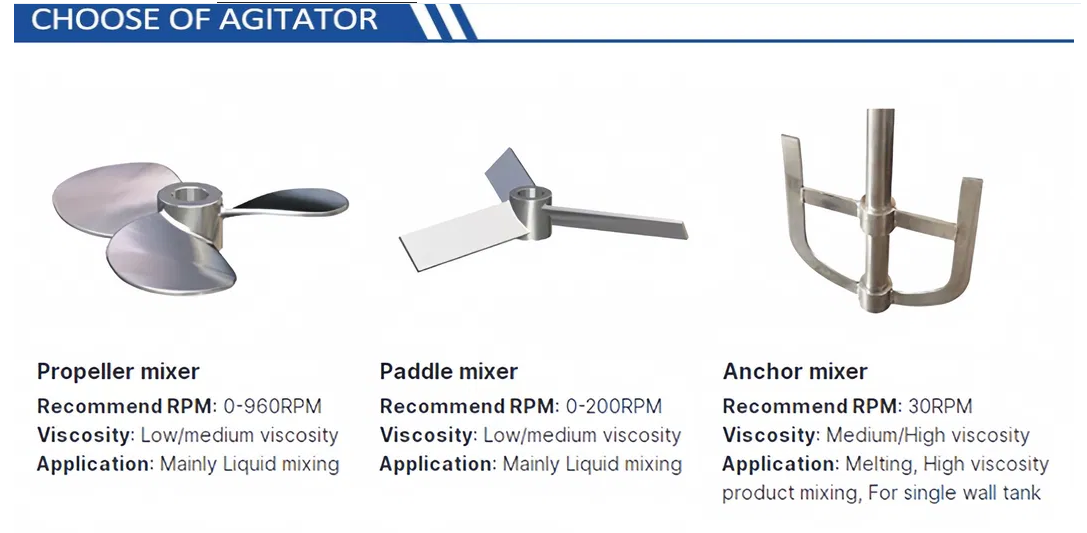
Have different kinds of agitators:
1, Bottom magnetic agitator with propeller impeller, speed from 50-400rpm or 50-800rpm. this kind of agitator is mixing thin viscosity , such as eyedrop, injection, CIP liquid, water, etc.
2, Top mechancial agitator with propeller impeller, speed at fix 71rpm or adjustable 20-200rpm or special requirement. this kind of agitator is mixing syrup, injection, blood, oral liquid, culture media, etc.
3, Top mechanical agitator with anchor or frame impeller, speed is from 10-70rpm. it is mixing higher viscosity , such as sediment or viscosity oral liquid, etc.
4, Top emusification homogenizer, speed max 2900rpm for small vessel, 1480rpm for bigger tank. this kind of agitator is mixing most high viscosity , such as suspension, oil, fat emulsification , etc.
5, Bottom emusification homogenizer, speed max 2900rpm for small vessel, 1480rpm for bigger tank. this kind of agitator is mixing most high viscosity , such as suspension, oil, fat emulsification , etc.
Working Principle
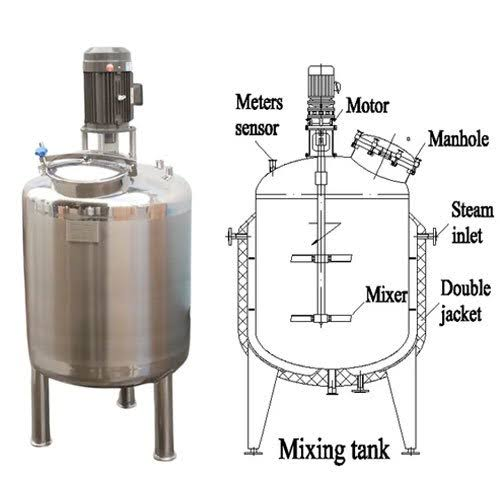
The stainless-steel sanitary mixing tank achieves uniform liquid blending by means of an internal agitator. When activated, the motor drives the agitator to generate flow patterns for thorough blending of ingredients. Baffles inside the tank break circular flow and boost mixing efficiency. Depending on application requirements, the tank may be equipped with temperature and pressure controls to support heating, cooling or vacuum processes. This guarantees batch-to-batch ingredient uniformity and sanitary conditions.
Capacity: 50L-10,000L
Surface finish: Inner surface Ra ≤ 0.6 μm
Agitator type: Top-mounted / Bottom-mounted / Magnetic-driven
Agitation speed: 10-300 rpm (adjustable)
Temperature range: -10°C to 150°C
Pressure: Atmospheric / Vacuum / Pressurized (≤0.3 MPa)
Jacket type: Single-layer / Double-layer / Spiral jacket
Standards: 3A, FDA, GMP
3-year quality warranty
ISO 9001, FDA, SGS certified materials Fast delivery within
7-10 days for urgent orders
20-year extensive export experience, delivering hassle-free custom-tailored services
Features
Widely adopted in high-purity industries, stainless-steel sanitary tanks feature the following prominent characteristics:
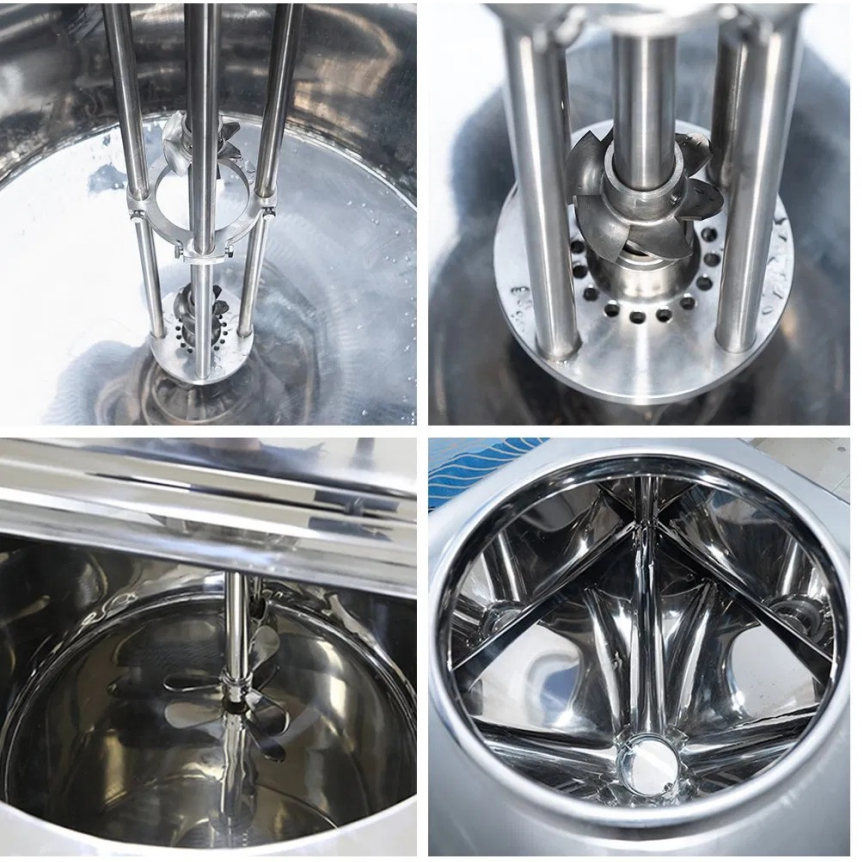
1. Sanitary inner surface The tank interior is polished to Ra ≤ 0.6 μm, eliminating liquid residue and bacterial growth while supporting convenient CIP/SIP cleaning.
2. Integrated agitation system Fitted with top-mounted or bottom-mounted agitators to realize uniform mixing, emulsification or dissolution according to process requirements.
3. Reinforced tank construction One-piece cylindrical body with dished top and bottom for enhanced strength, stability and pressure resistance.
4. Flexible jacket design Available in single-layer, double-layer or spiral jackets for heating or cooling, suitable for temperature-sensitive processes.
5. Multiple connection standards Compatible with Tri-Clamp, DIN, SMS or threaded connections for easy integration into existing sanitary systems.
6. Modular & customizable design Optional components including level sensors, manholes and spray nozzles. Tanks can be custom-built for specific process requirements.
Advantages
1. Smooth inner walls prevent residue accumulation and microbial proliferation.
2. High-efficiency mixing ensures consistent product quality for every batch cycle.
3. Accurate temperature control for sensitive product formulations.
4. Heavy-duty construction extends service life and lowers maintenance costs.
5. Flexible integration with existing sanitary production systems.
6. Customizable design accommodates diverse process and spatial constraints.
Benefits
1. Guarantees product purity and compliance with GMP, FDA and 3A standards.
2. Improves production efficiency and consistency of batch quality.
3. Reduces cleaning time and labour costs via CIP/SIP capability.
4. Minimizes downtime thanks to reliable, easy-to-perform maintenance.
5. Boosts operational flexibility for diverse liquid-processing workflows.
6. Enhances process control and traceability with optional sensor assemblies.
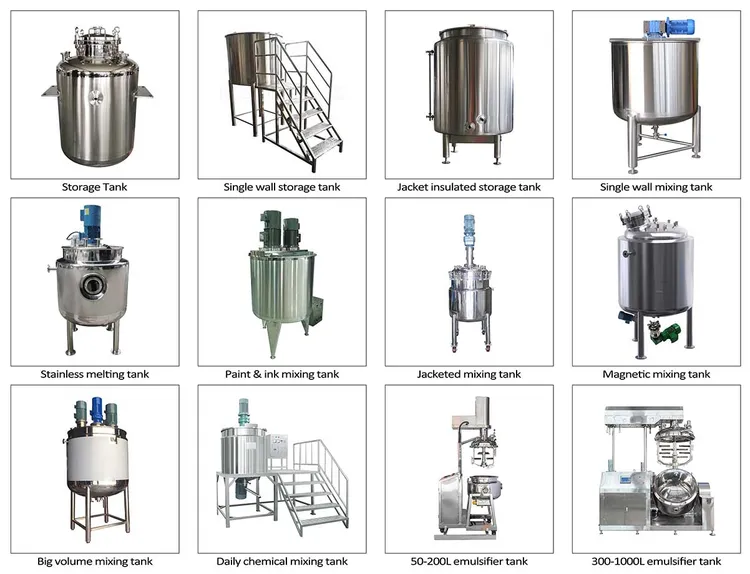
Related Product Display
FAQ
Q: How about payment term, payment safety and delivery time?
A: We accept 40% deposit, balance before shipment. And Irrevocable L/C at sight.Delivery time is 7 to 30 days. It is according to order quantity.
Q: How could we confirm the products?
A: Our professional engineers will follow up all the designs and ajustments according to your requirement.OEM and ODM available.
Q: What services can we provide?
A:Accepted Delivery Terms: FOB,CFR,CIF,EXW,DDP,DDU,Express Delivery;
Accepted Payment Currency:USD,EUR,CNY;
Accepted Payment Type: T/T,L/C,Credit Cardl,Western Union,Alipay;
Q: How can I know your machine works well?
A: Before delivery, we shall test the machine working condition for you.
Q: What's your MOQ?
A: 1 set.
Process SUS304/316L Buffer Mixing & Blending Tank – Complete Industry Guide
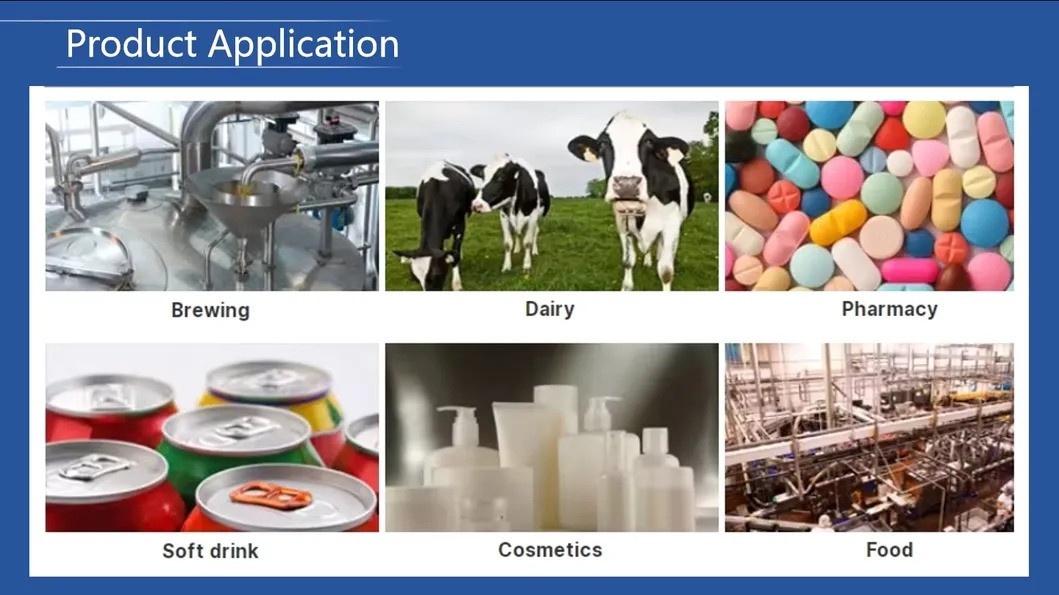
Application of Mixing & Blending Tank
Mixing-blending tanks are applied for agitating, mixing, blending and homogenizing materials. Made of Stainless steel, they can be standardized and human-oriented optimized in design and configuration according to production process requirements. Manual and automatic controls for feeding, discharging, agitation and other operations can be realized during blending.
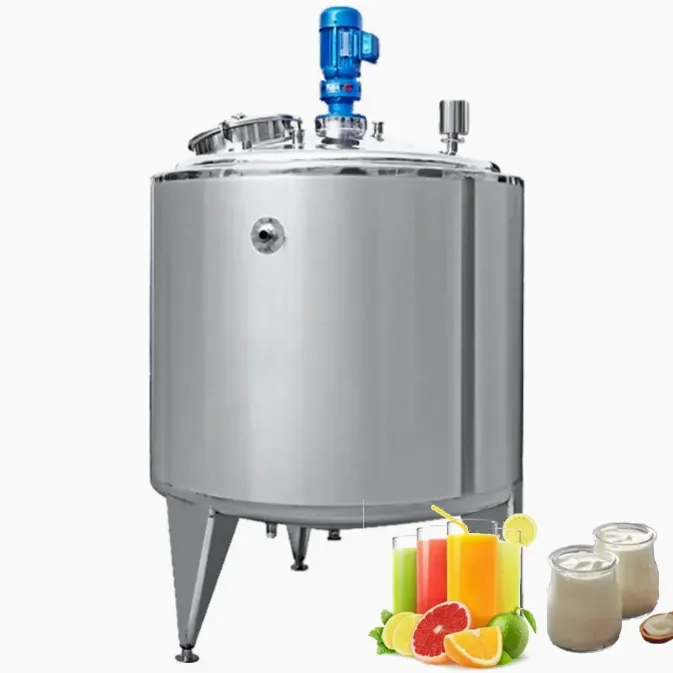
The tank supports heating, cooling, heat preservation, stirring and metering functions, and is widely used in food and beverage industries. Heating & cooling systems, low-speed agitation systems, sealed pressure-bearing systems, vacuum systems and metering systems can be designed to match production processes.
Agitator impeller configurations can be adjusted based on different feed materials and target mixing performance, including turbine-type, paddle-type, anchor-type, frame-type, ribbon-type and magnetic-driven agitation modes. Depending on material ratio and physical state, gravimetric batching, flow metering or level measurement can be adopted for batching operations.
Soft Drinks: Blending tanks mix water, flavorings, sweeteners and carbonation agents to produce soft drinks and energy drinks with consistent taste and quality.
Juices & Fruit Purées: Tanks blend concentrated juice, fruit pulp, water and other ingredients to produce well-homogenized juice products.
Alcoholic Beverage Production:
-Beer: Blending tanks play a critical role in brewing. They mix malt extract, hops, water and other components to prepare wort, the precursor of beer.
-Spirits: For spirits such as vodka or whisky, tanks blend different grains, water and yeast during fermentation.
Dairy Processing:
-Milk Standardization: Mixing tanks blend cream and milk to achieve uniform fat content for milk standardization.
-Yoghourt Production: Tanks mix milk, starter cultures and other additives for yoghurt production to guarantee consistent texture and flavour.
Sauces & Condiments:
-Ketchup & Dressings: Mixing tanks blend tomato paste, chilli sauce, fruits, spices and other ingredients to make ketchup and condiments with stable taste and texture.
- Mayonnaise & Salad Cream: Tanks blend oil, vinegar, egg and other raw materials for mayonnaise and salad dressing production.
-Jam: Vacuum mixing-agitation tanks produce jams by blending sugar, pectin, acid and fruit purée for stable-quality jam products.
Plant-based Milk: Plant-milk products are manufactured by blending plant substrates (soy base, oat base, almond base, coconut base, etc.), water, flavourings and other components.
Structure of Mixing & Blending Tank
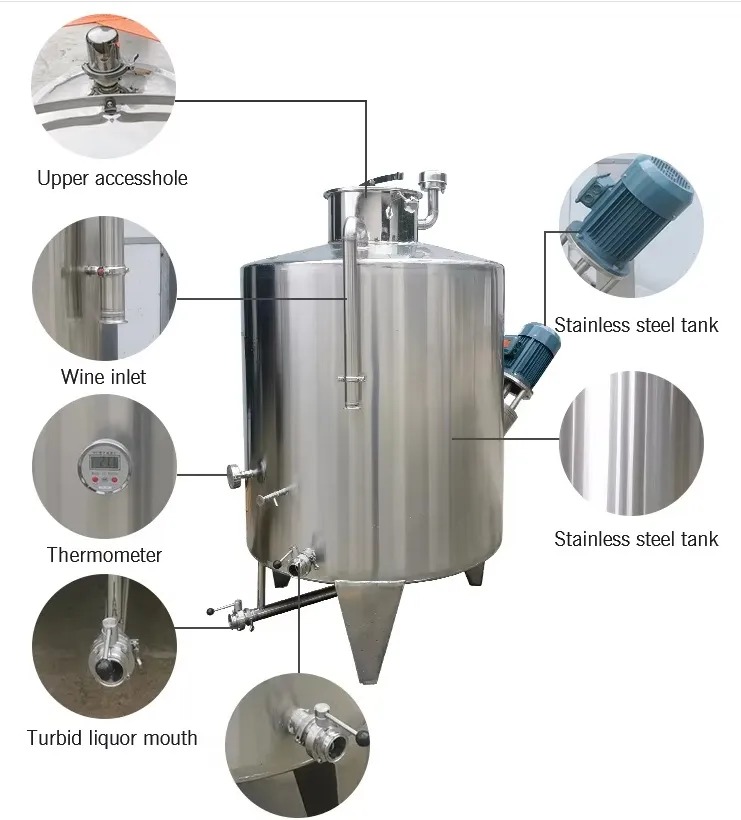
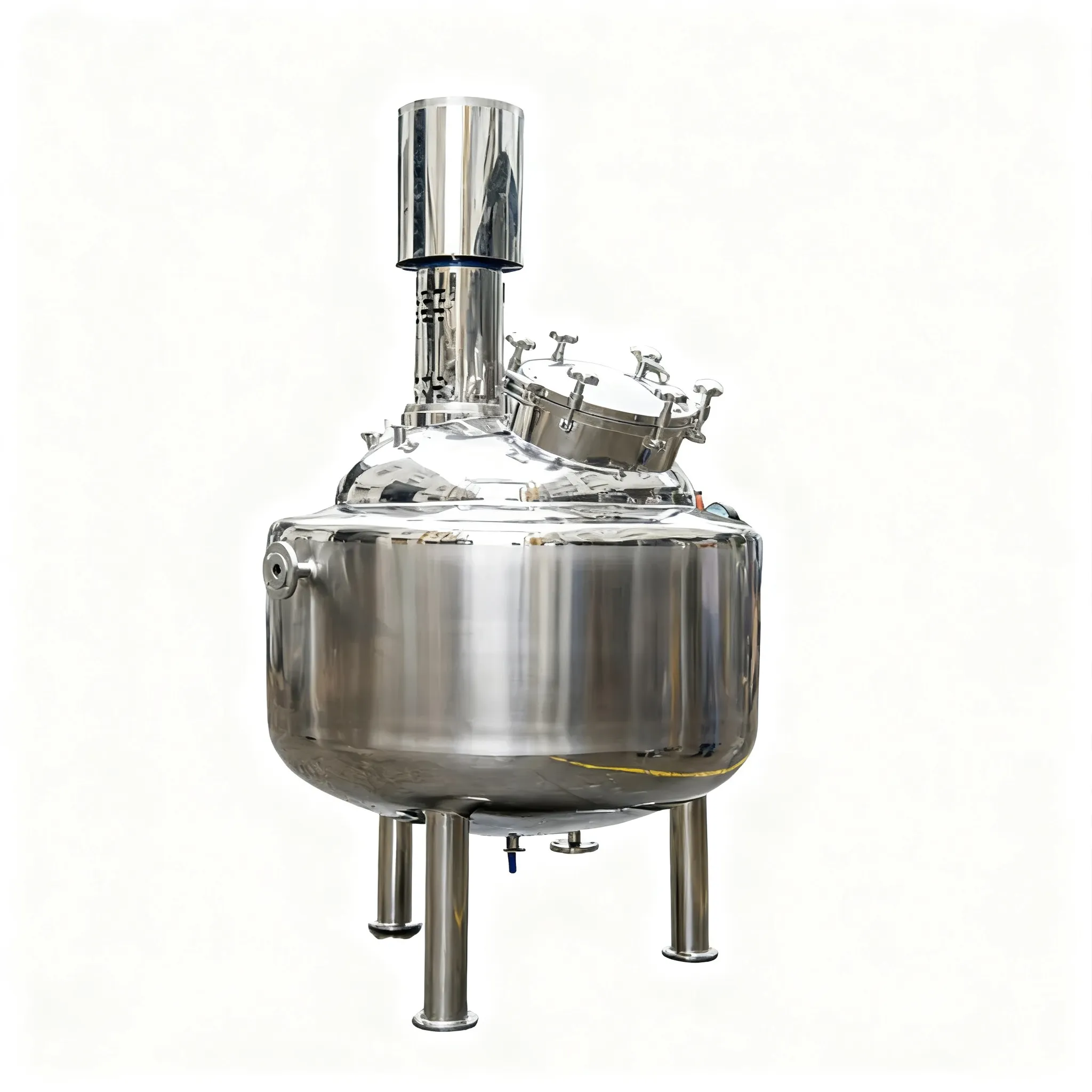
A mixing-blending tank consists of tank body, tank cover, agitator, support frame, drive unit and shaft seal assembly. Heating or cooling jackets can be equipped per process requirements.
The tank body and cover can be connected by flange sealing or welding. Process nozzles for feeding, discharging, observation, temperature measurement, pressure measurement, steam venting and safety exhaust can be opened on tank body & cover as required. Drive assemblies (motor / reducer) are mounted on top of tank cover; the internal agitator is driven by transmission shaft. Impeller options include paddle-type, anchor-type, frame-type, helical-type and others for different production workflows.
Equipment Auxiliary Options
Quick-open sanitary manhole, sight glass with light fitting, thermometer, breather filter, CIP sprayer, material inlet & outlet ports, sampling port, SIP sterilization port, level sensor port, hot/cold medium inlet & outlet ports and other connections.
Complete system configuration covers drive unit, mechanical seal, temperature control unit, lamp fitting, sight glass, mixing assembly, manhole feed port, cleaning ball, steam inlet, condensate outlet, material discharge port, waste-water outlet, sampling port, 360° universal CIP ball. Weighing assembly and level-measuring device are optional for certain units.
Functional Specifications of SUS304/316L Mixing & Blending Tank
1. Heating Modes
①Electric immersion heaters fitted inside jacket chamber; thermal-oil or hot-water serves as heating medium inside jacket for uniform heat distribution.
②Steam heating inside jacket or internal coils. Full-jacket steam heating belongs to pressure-vessel scope; semi-coil external steam heating is generally recommended for cost saving.
③Circulating heating: media pre-heated by external heaters are circulated through the jacket by pumping system. Circulation piping shall be insulated for heat retention and minimize thermal loss.
2. Max. Material Heating Temperature: ≤320°C. Heating modes, electric heater power, steam pressure or thermal-medium temperature are selected according to target temperature and heating-time requirements.
3. Temperature Control: Thermocouple with thermal insulation and PID constant-temperature control; temperature tolerance ±1°C. Options include digital thermometer display, temperature sensor with controller, or dual-point temperature measurement for monitoring & control.
4. Tank Body: Inner surface mirror-polished, surface roughness Ra ≤0.4 μm. Outer surface: mirror polish or 2B finish plate.
5. Top Cover: Two hinged opening lids. Tank bottom options: sloped bottom, conical bottom, elliptical / dished head for easy cleaning. Alternative: top-and-bottom conical heads or top-and-bottom elliptical / dished heads. Inner surface mirror-polished (Ra ≤0.4 μm); outer surface mechanically polished to Ra ≤0.8 μm.
6. Tank Bottom Construction: Spin-formed with rounded corner transition, welded and polished to eliminate dead corners. 5° inclination towards discharge port enables complete material draining without residual buildup.
7. Jacket Types: Full jacket, semi-coil jacket, detachable jacket; selected according to heating solution.
8. Insulation Layer: Filled with EPE foam, rock-wool or polyurethane to maintain temperature gradient for thermal insulation.
9. Outer Shell Finish: Mirror polishing, 2B matte finish or sand-blasting.
10. Agitation Assembly: Top-mounted (eccentric) agitation. Reducer output shaft connects to impeller shaft via detachable coupling for easy disassembly and cleaning.
11. Agitation Speed: 0-60 rpm (fixed speed or custom variable speed). Impeller types: frame-type, anchor-type, paddle-type, turbine-type, etc. Custom impeller designs available for special process requirements.
12. Tank Configuration: Electrical control cabinet (thermometer, level measurement, pressure indicator, switches, signal lamps, spotlight switch etc.), manhole, material inlet & outlet, hot/cold medium ports, spare nozzles, cleaning port, sterilization port, sampling port, thermometer port, pressure gauge port, vacuum port and others.
13. Material Specification: Inner vessel: SUS304 or SUS316L; Jacket: Q235-B or SUS304; Outer insulation shell: SUS304.
14. Nozzle Welding: All process nozzles and inner-vessel weld joints adopt flanged transition & arc-welding technique. Smooth surfaces with no sanitary dead corners and aesthetic appearance for easy cleaning.
Main Components of SUS304/316L Mixing & Blending Tank
-Tank shell: 5-6 mm thickness 2B-matte stainless-steel plate with elliptical top-bottom heads (for vacuum mixing); 2-3 mm thickness 2B-matte stainless-steel plate with conical top-bottom heads (for vacuum mixing tank).
-Vacuum system (vacuum pump + condenser): for vacuum-mixing version only.
-Manhole
-Sampling valve
-Material inlet & outlet; hot-cold medium inlet & outlet ports
-CIP cleaning ball
-Material discharge valve
-Breather filter
-Temperature sensor
-Level sensor
-Electronic control system
-Steam control valve system (Spirax Sarco)
-Mettler Toledo load
-cell sensors
-Agitator (single-agitator / dual-agitator / triple-agitator customizable)
-Access ladder
Technical Parameters of SUS304/316L Mixing & Blending Tank
Item | Specification |
Nominal Volume | 500 L-15000 L |
Inner Diameter (mm) | 500-2540 mm |
Heat-exchange Area (m²) | 0.9, 2.0, 2.7, 4.5, 7.5, 10.0, 13.5, 22, 25, 27 |
Agitator Power (kW) | 0.55-7.5 kW |
Rotational Speed | Fixed speed or VFD variable speed |
Working Temperature | 0-180°C |
Jacket Heating / Cooling Media | Steam / Cooling water / Thermal oil / other refrigerants |
Metering Mode | Gravimetric batching, level measurement or flow measurement |
Nozzle Layout | Custom-designed per project requirements |
Tank Material | SUS304 / SUS316L |
Material Properties | pH value, viscosity, boiling point, toxicity, solid-liquid ratio, etc. |
Operating Conditions | Temperature, pressure, etc. |
Installation Style | Vertical / Horizontal / Tiltable / Mobile / Platform-mounted (optional) |
Heating Mode | Electric heating, steam heating, circulating heating, coil heating (optional) |
Heating Medium | Water, thermal oil, steam (optional) |
Jacket Type | Flat-top jacket, dimple jacket, semi-circular coil jacket, detachable jacket |
Insulation Material | EPE foam, rock-wool, polyurethane (optional) |
Agitator Impeller Type | Paddle-type, turbine-type, anchor-type, frame-type, magnetic-driven stirring, etc. |
Surface Treatment | Mechanical polishing, sand-blasting, 2B plate brushed finish |
21. FAQ
Q1: What is a Process Buffer Mixing & Blending Tank used for?
It is used for mixing, buffering, and stabilizing liquids in industrial production systems.
Q2: What materials are used?
SS304 and SS316L stainless steel are most common.
Q3: Is it suitable for food production?
Yes, it is widely used in food and beverage industries.
Q4: Does it include mixing systems?
Yes, it typically includes agitators or high-shear mixers.
Q5: Can it be temperature controlled?
Yes, via heating or cooling jackets.
22. Conclusion
The Process Buffer Mixing & Blending Tank is a core component in modern industrial production systems, enabling stable flow, consistent blending, and efficient process control. With its sanitary stainless steel structure, advanced mixing technology, and flexible design options, it is widely used across food, pharmaceutical, chemical, and biotechnology industries.
 +86 29-87031531







 Phone
Phone