Small-scale Yogurt Production Line
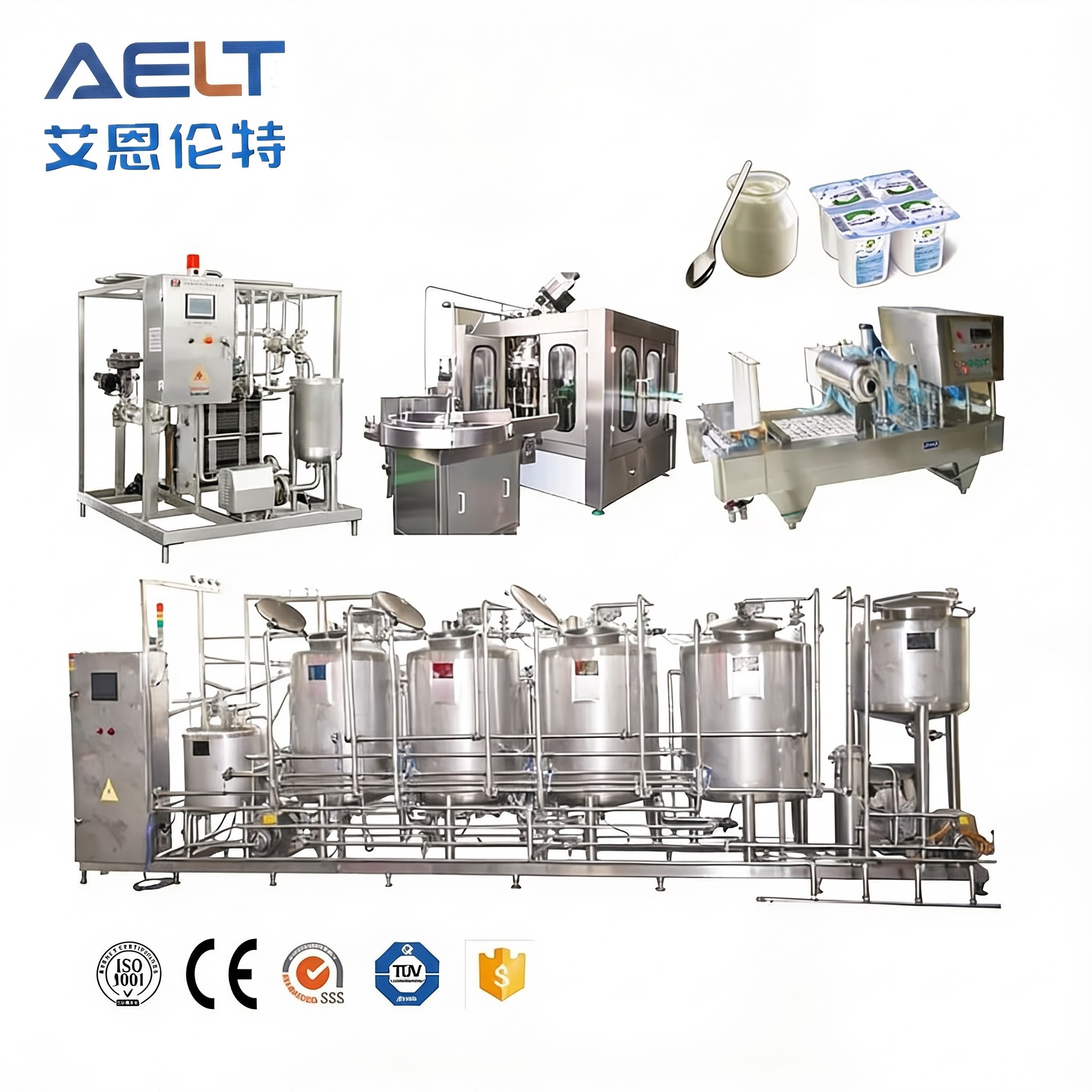
The yogurt production line is a fully-automatic industrial system that converts raw cow milk or milk powder into fermented dairy products through precise pre-treatment, sterilization and packaging stages.
PRODUCT DESCRIPTION
Description
This milk processing production line manufactures various commercial milk products, including whole milk, skimmed milk and standardized milk with different fat contents.
Raw materials for this line can be fresh raw milk or milk powder. Processing options include pasteurization, high-temperature short-time sterilization or UHT ultra-high-temperature sterilization.
Final products can be packed in plastic bags, plastic cups, plastic bottles, glass bottles, gable-top cartons, pre-made pouches, paper cartons and other formats. Process design varies according to finished-product types and packaging formats. The general workflow is as follows: Milk Reception → Pasteurization → Homogenization → Yogurt Production → Milk Storage → Packaging → Cold Storage → Hot Water Generator → Laboratory → Installation & Commissioning.
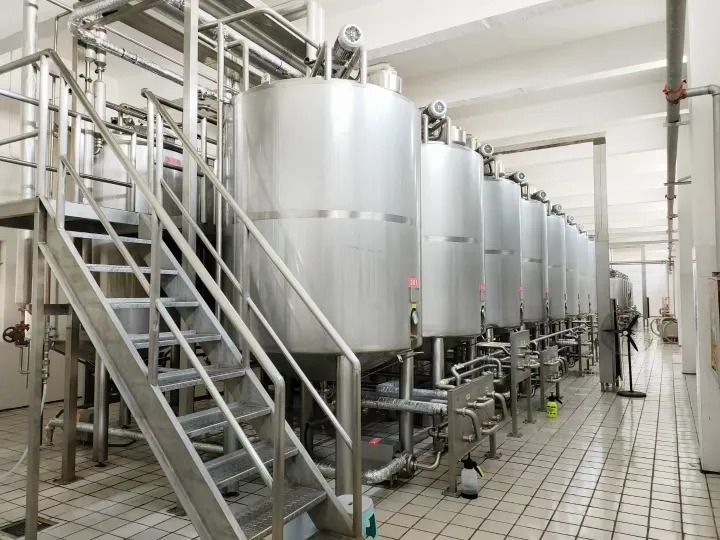
Key Production Steps
Milk Reception and Storage: Raw cow milk is collected and refrigerated in insulated storage tanks at 3–6 °C.
Filtration and Pre-heating: Single-stage or two-stage filters first remove large physical impurities. Milk pumps then deliver the liquid to pre-heaters to raise its temperature to 40–50 °C.
Homogenization: A high-pressure homogenizer breaks down fat globules in milk to achieve a smooth and uniform texture.
Sterilization: Milk undergoes pasteurization (typically heated to around 85 °C and held for 30 minutes, or treated by ultra-high-temperature instant sterilization) to eliminate harmful pathogens and stabilize the base material.
Inoculation and Fermentation: Sterilized milk is cooled down to a specific incubation temperature, then inoculated with active starter cultures such as Streptococcus thermophilus and Lactobacillus bulgaricus in insulated fermentation tanks.
Cooling and Post-treatment: Once fermentation reaches the target acidity (approximately pH 4.5), the yogurt is rapidly cooled and mixed with flavorings, stabilizers or fruit jam.
Filling and Packaging: Automatic rotary or inline machines perform cup dispensing, liquid filling, film sealing and final coding for subsequent distribution.
Application Field
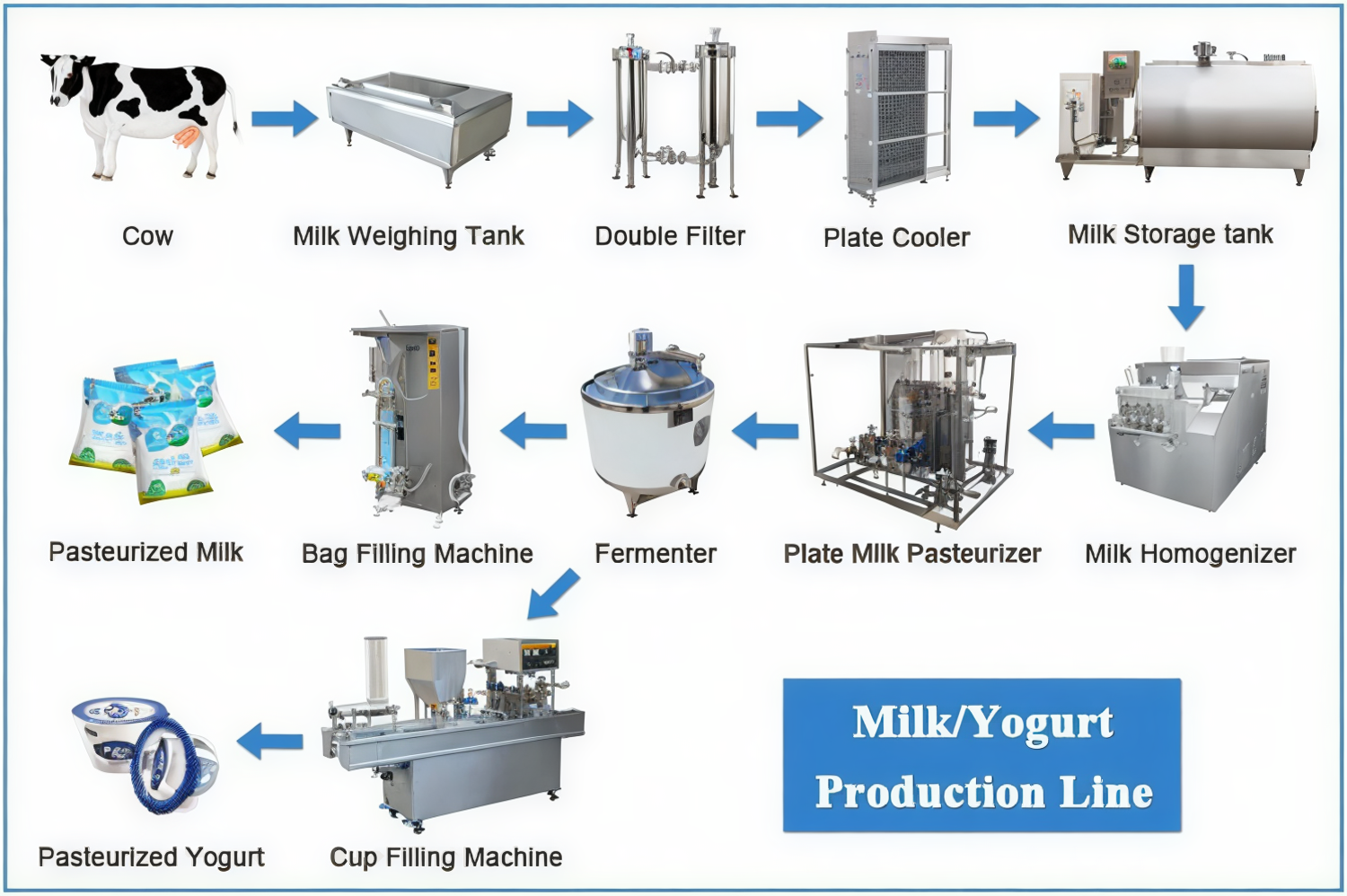
This Small-scale Yogurt Production Line is widely applied in formula confirmation and upgrading for fresh milk, soymilk, biopharmaceuticals, bean products, liquid condiments and other products. It is also used for flavor screening, color evaluation, stabilizer / emulsifier addition, new-product development and batch production. The pasteurizer integrates heating, sterilization, cooling and hot-filling functions into one unit.
FAQ
Q: What about payment terms, payment security and lead time? A: We accept 40% advance deposit, with the balance to be paid before shipment. Irrevocable Letter of Credit at Sight is also acceptable. The lead time ranges from 7 to 30 days, subject to order quantity.
Q: How can we confirm product specifications? A: Our professional engineers will follow up all design and adjustments based on your requirements. OEM and ODM services are available.
Q: What services can you provide? A: Accepted delivery terms: FOB, CFR, CIF, EXW, DDP, DDU, Express; Accepted currencies: USD, EUR, CNY; Accepted payment methods: T/T, L/C, Credit Card, Western Union, Alipay.
Q: How can we make sure your machines work properly? A: We will test machine performance for you before delivery.
Q: What is your minimum order quantity? A: 1 set.
Complete Technical Guideline for Small-Scale Yogurt Fermenter, Stirred-Type Yogurt Production Line, Plain Yogurt Processing Plant
Covers: Process Flow, Equipment List, Process Parameters, Operating Key Points, Quality Control, Cleaning & Sterilization, Common Troubleshooting. For liquid stirred-type yogurt and set-type yogurt. Reference for GMP production in small-and-medium-sized factories.
I. Basic Classification of Yogurt
1. Set-type Yogurt: Fermented after filling, cup-packaged, solid finished product.
2. Stirred-type Yogurt: Curd is broken and stirred after fermentation, then filled. Mainstream commercial type, fruit granules can be added.
II. Complete Process Flow (Standard Stirred-type Yogurt)
Raw Milk Acceptance → Pre-treatment (Filtration & Clarification) → Batching (Sugar / Milk Powder Addition) → Pre-heating → Homogenization → Sterilization → Cooling → Starter Inoculation → Constant-temperature Fermentation → Curd Breaking & Stirring → Cooling & Post-ripening → Fruit Mixing (Optional) → Aseptic Filling → Cold Storage Post-ripening → Finished-product Warehousing
Difference for Set-type Yogurt: Inoculation followed by direct filling → Constant-temperature fermentation after filling → Cold-storage post-ripening
1. Raw Milk Acceptance
- Raw materials: Fresh cow milk / Reconstituted milk (rehydrated milk powder)
- Specifications: Protein ≥3.0%, fat 3.2-3.8%; Acidity 16-18 °T; Antibiotic-free, impurity
-free; total bacterial count complies with standards.
Antibiotic residues will directly cause fermentation failure; this item is mandatory for inspection.
2. Pre-treatment
1. Filtration: Duplex filter to remove hairs and impurities.
2. Milk clarification by centrifugation: Clarifier to remove somatic cells and fine impurities.
3. Batching
-White granulated sugar dosage: 6-8%. For premium products, skim milk powder can be added to raise total solids; total milk solids: 11.5-14%.
-Dissolve sugar and milk powder in warm water, pump into batching tank, mix thoroughly with fresh milk.
-If stabilizers (pectin, gelatin, agar) are required, dissolve them in warm water in advance to avoid caking.
3. Pre-heating
Pre-heat to 55-65 °C via plate heat exchanger, preparing for homogenization.
4. Homogenization
-Temperature: 55-65 °C
-Pressure: 1st stage 15-20 MPa, 2nd stage 3-5 MPa
-Function: Break fat globules; prevent yogurt stratification and whey separation; deliver smooth mouthfeel.
5. Sterilization (Critical Yogurt-making Step)
Pasteurization standard: 90-95 °C, hold for 300 seconds (5 minutes). UHT ultra-high-temperature sterilization shall not be adopted, as it impairs fermentation flavor.
Purposes: Kill pathogenic bacteria and miscellaneous bacteria; denature milk protein; improve yogurt gel strength and reduce whey separation.
6. Cooling
Rapidly cool down to 42-43 °C by plate heat exchanger, the optimal inoculation temperature for cultures. Excessively high temperature kills strains; too low temperature slows fermentation.
7. Inoculation of Fermentation Cultures
Common mixed cultures: Streptococcus thermophilus + Lactobacillus bulgaricus
-Dosage: Commercial direct-vat-set starter 0.01-0.03% (follow strain supplier’s manual).
- Operation: Add into fermentation tank under aseptic conditions; stir at low speed for 10-15 min for uniform mixing; avoid excessive air intake.
8. Constant-temperature Fermentation (For Stirred�type Yogurt)
Maintain fermentation tank at 41-43 °C, static fermentation; stirring is forbidden.
Termination criteria (meet either one):
1. Titratable acidity reaches 70-80 °T;
2. pH drops to 4.4-4.6.
Fermentation duration: 2.5-4.5 h.
-pH<4.2: Over-acidic, sharp sour taste.
-pH>4.7: Insufficient fermentation, loose texture prone to whey leakage.
9. Curd Breaking & Stirring (Stirred-type Only)
Once fermentation reaches target, activate tank cooling immediately to lower temperature to 20-22 °C. Break curd with low-speed stirring. Avoid excessive rotation speed which draws large volume of air and results in thin yogurt.
10. Post-ripening Cooling
Cool rapidly to 4-8 °C to restrain further acid production by strains, proceed to cold-storage post-ripening for flavor development.
Fast cooling is required. Slow cooling causes continuous acid generation and over-sour yogurt.
11. Fruit Mixing (Optional)
Sterilize and cool fruit granules / jam in advance. Mix into yogurt via fruit feeder under aseptic condition at temperature ≤10 °C to prevent fruit deterioration.
12. Aseptic Filling
-Material temperature: 4-8 °C
-Equipment: Cup filler / bottle filler; CIP cleaning & sterilization for equipment pipelines.
-Filling environment: Clean workshop, Class 10 000 / Class 100 000 cleanliness level.
13. Cold-storage Post-ripening & Warehousing
Store finished goods in cold warehouse at 2-6 °C for 12-24 h to complete post-ripening. Whole cold-chain required for outbound delivery. Shelf-life: Conventional yogurt 2-21 days.
Process difference for set-type yogurt: Fill directly into cups and seal after inoculation; send to fermentation room for fermentation at 42 °C until pH 4.4-4.6; transfer immediately to cold storage at 4-6 °C for post-ripening.
III. Full-set Production-line Equipment List (Small-and-medium-size, 500-2000 L/h)
1. Raw milk tank / Batching tank (with agitator, jacket heat exchange)
2. Duplex filter
3. Centrifugal milk clarifier
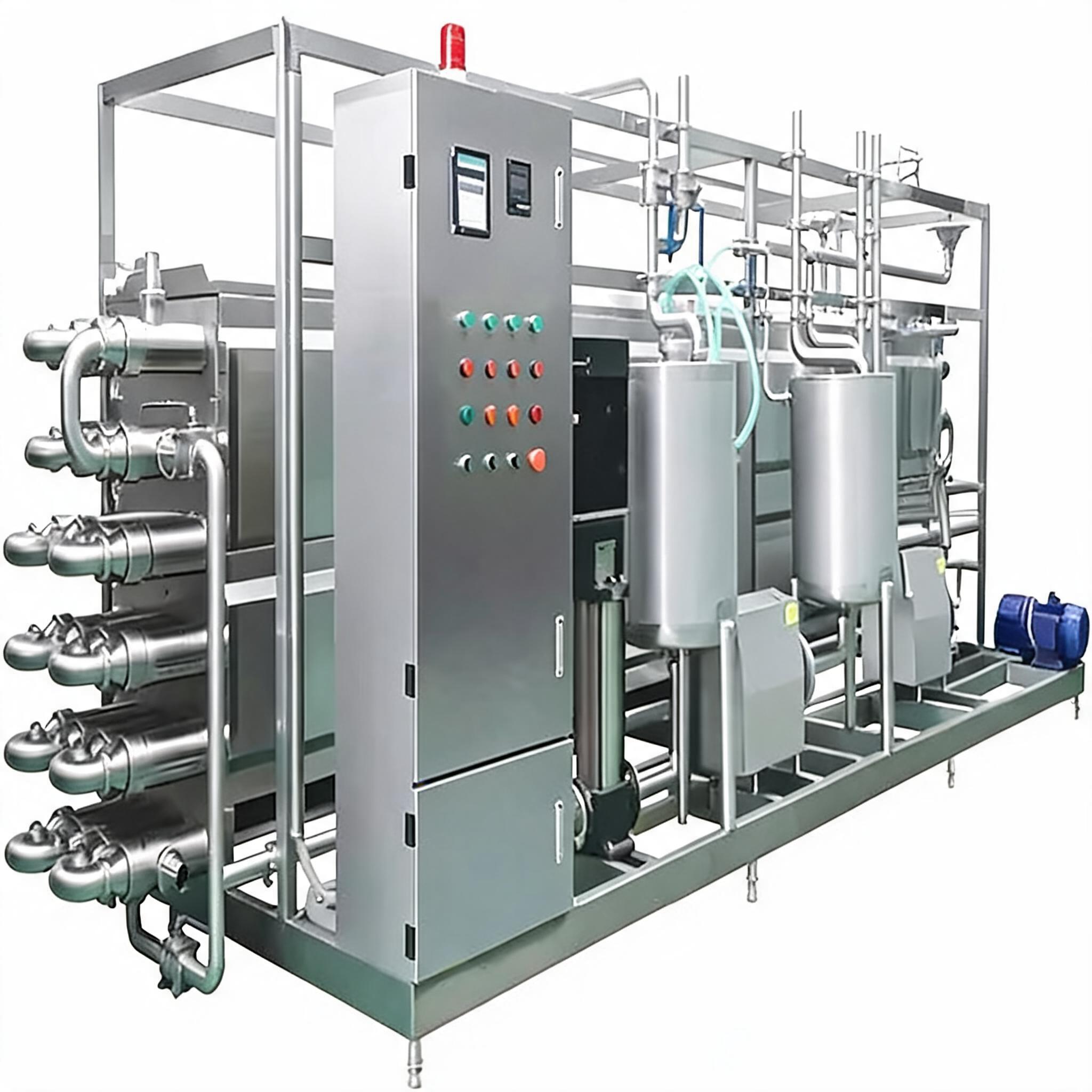
4. Plate heat exchanger (integrated for pre-heating-sterilization-cooling)
5. High-pressure homogenizer
6. Insulated fermentation tank (jacket temperature control, stirring, pH / temperature probes)
7. CIP Cleaning-in-Place System (acid tank, alkali tank, hot-water tank)
8. Fruit dosing system (optional)
9. Automatic cup / bottle filling machine
10. Constant-temperature fermentation chamber (for set-type yogurt)
11. Chiller unit (supply ice-cold water)
12. Cold warehouse (2-6 °C)
13. Laboratory instruments: pH meter, acidity titration set, colony-count testing equipment
IV. Summary of Key Process Parameters
Process | Temperature | Key Parameters |
Homogenization | 55-65 °C | 1st-stage 15-20 MPa, 2nd-stage 3-5 MPa |
Sterilization | 90-95 °C | Hold for 5 min |
Inoculation | 42-43 °C | Aseptic addition of direct-vat-set starter |
Fermentation | 41-43 °C | End-point pH 4.4-4.6; acidity 70-80 °T |
Curd-breaking & Cooling | Rapidly cool to 20 °C | Low-speed stirring, minimal air intake |
Filling material temperature | 4-8 °C | Aseptic filling |
Finished-product storage | 2-6 °C | Full cold-chain logistics |
V. CIP Cleaning & Sterilization Protocol (Mandatory for production; prevent contaminants & phage)
CIP shall be performed after each production run and for batch change-over:
1. Pre-rinse: Flush residual materials inside pipelines with clean water.
2. Alkali washing: 1-2% NaOH solution, circulate at 75-80 °C for 15-20 min.
3. Flush off alkali residue with clean water.
4. Acid washing: 0.5-1% nitric acid, circulate at 60-70 °C for 10-15 min to remove milk stone.
5. Rinse with clean water until neutral pH is reached.
6. Pre-production sterilization: Circulate hot water at 85-90 °C for 20-30 min to sterilize inner surfaces of tanks and pipelines.
All yogurt-contact tanks, pipelines, valves and filler pipelines must go through CIP. Phage poses major hazard for yogurt plants. Strict cleaning-disinfection and regular workshop environmental sanitization are required.
VI. Common Production Problems & Root Causes
1. No fermentation, acidity fails to rise -Raw milk contains antibiotics; starter inactivation; excessive inoculation temperature killing strains; improper fermentation temperature; contamination by miscellaneous bacteria / phage.
2. Heavy whey separation, excessive water release -Insufficient sterilization; inadequate homogenization pressure; over-fermentation with too-low pH; slow cooling; high stirring speed bringing in air; insufficient total solids.
3. Thin yogurt without gel formation -Low protein content of raw milk; insufficient sterilization time leading to inadequate protein denaturation; incomplete fermentation; phage contamination.
4. Over-acid finished product with sharp sour taste -Over-long fermentation time; delayed cooling; broken cold-chain and elevated storage temperature.
5. Package bulging & off-odor -Microbial contamination; unhygienic filling environment; incomplete CIP cleaning.
VII. Workshop & GMP Management Key Points
1. Production-area zoning: Raw-material zone, sterilization-fermentation zone, filling clean zone, cold warehouse. Separate personnel flow and material flow.
2. Air purification for filling zone; staff gown-changing and disinfection.
3. Complete temperature records for raw materials, semi-finished goods and finished products; test pH, acidity and sensory properties for each batch.
4. Starter storage: Direct-vat-set starters stored frozen at -18 °C.
VIII. Supplement: Formulation Example (Basic Formula for Stirred-type Yogurt)
Total input 1000 kg: Fresh cow milk 920 kg, white granulated sugar 70 kg, skim milk powder 10 kg; total solids ≈12.5%. Add direct-vat-set mixed starter per manufacturer’s instructions.
Upon request I can further deliver:
1. Yogurt production-line equipment layout drawing scheme
2. SOP Standard Operating Procedure documents
3. English-language process specification (for equipment procurement & foreign trade)
4. Small-scale lab trial formula
 +86 29-87031531



 Phone
Phone